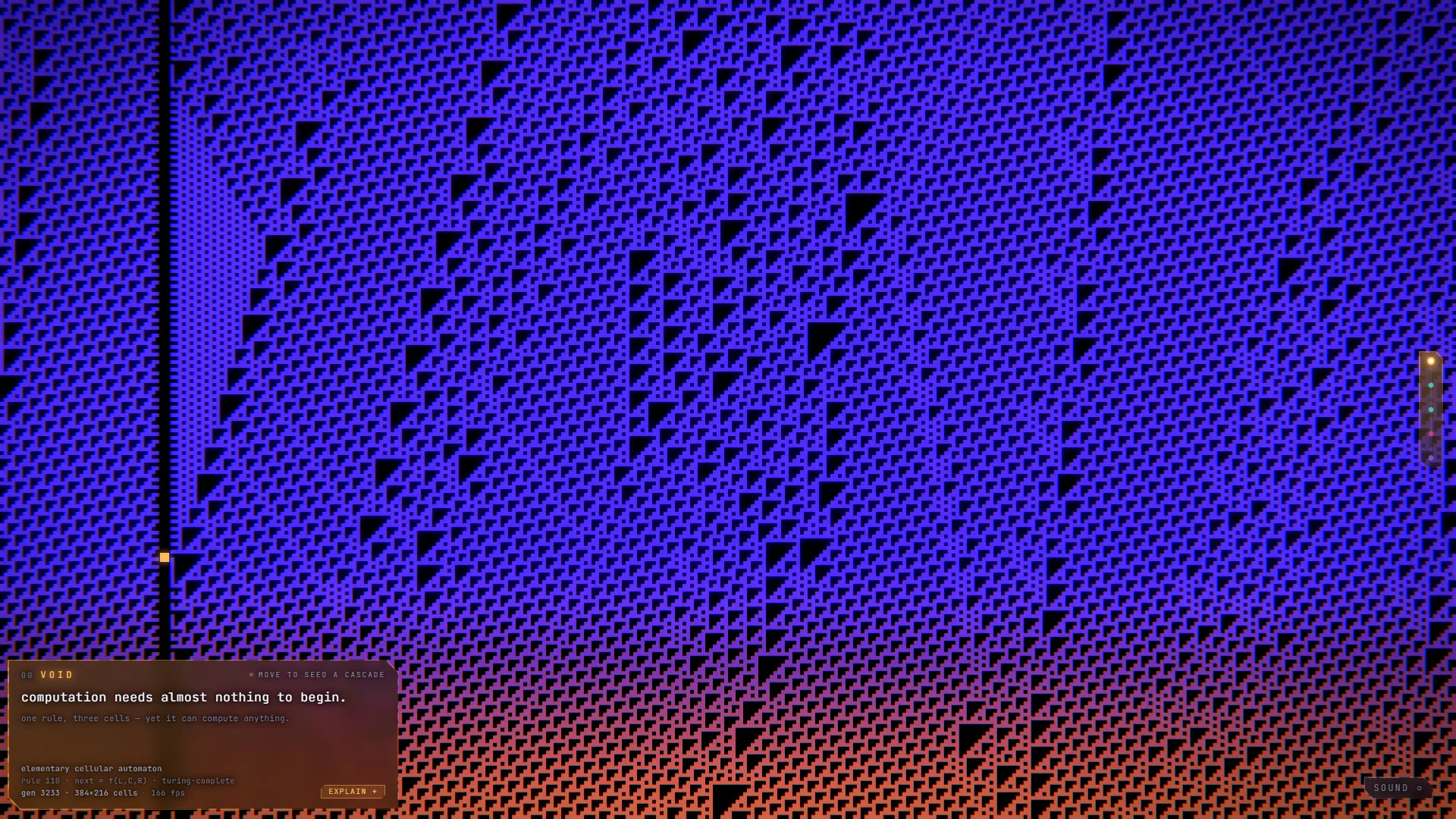
01Void
Eight bits, one bit shift
A one-dimensional automaton, Wolfram’s Rule 110. Each cell sees its two neighbours, and the rule number is the truth table for it. In 2004 Cook proved that this rule is Turing-complete. The core is four lines.

Five simulations, computed live in the browser and connected by scrolling. Each system hands its state on to the next.
2026Concept and developmentJavaScript · GLSL · three.js · Vite · Docker
Starting point
Emergence is the point at which simple local rules give rise to behaviour that none of those rules contains. A text about it remains a claim, and a recording only shows that it once looked like this. Here the visitor steps in: a click seeds a cell, the pointer tears a hole in the swarm. You don’t have to take it on trust that nothing is recorded.
The systems

01Void
A one-dimensional automaton, Wolfram’s Rule 110. Each cell sees its two neighbours, and the rule number is the truth table for it. In 2004 Cook proved that this rule is Turing-complete. The core is four lines.
02Life
Conway’s B3/S23 rule, seeded from the history of the automaton before it. The state lives in a texture and is computed in the shader, eight generations per second. The brush under the pointer is a separate pass.
03Flock
Up to 16,384 agents following Reynolds, 1987: keep your distance, match direction, stay together. Each bird orients itself by its seven nearest neighbours, just as Ballerini measured in real starlings in 2008.
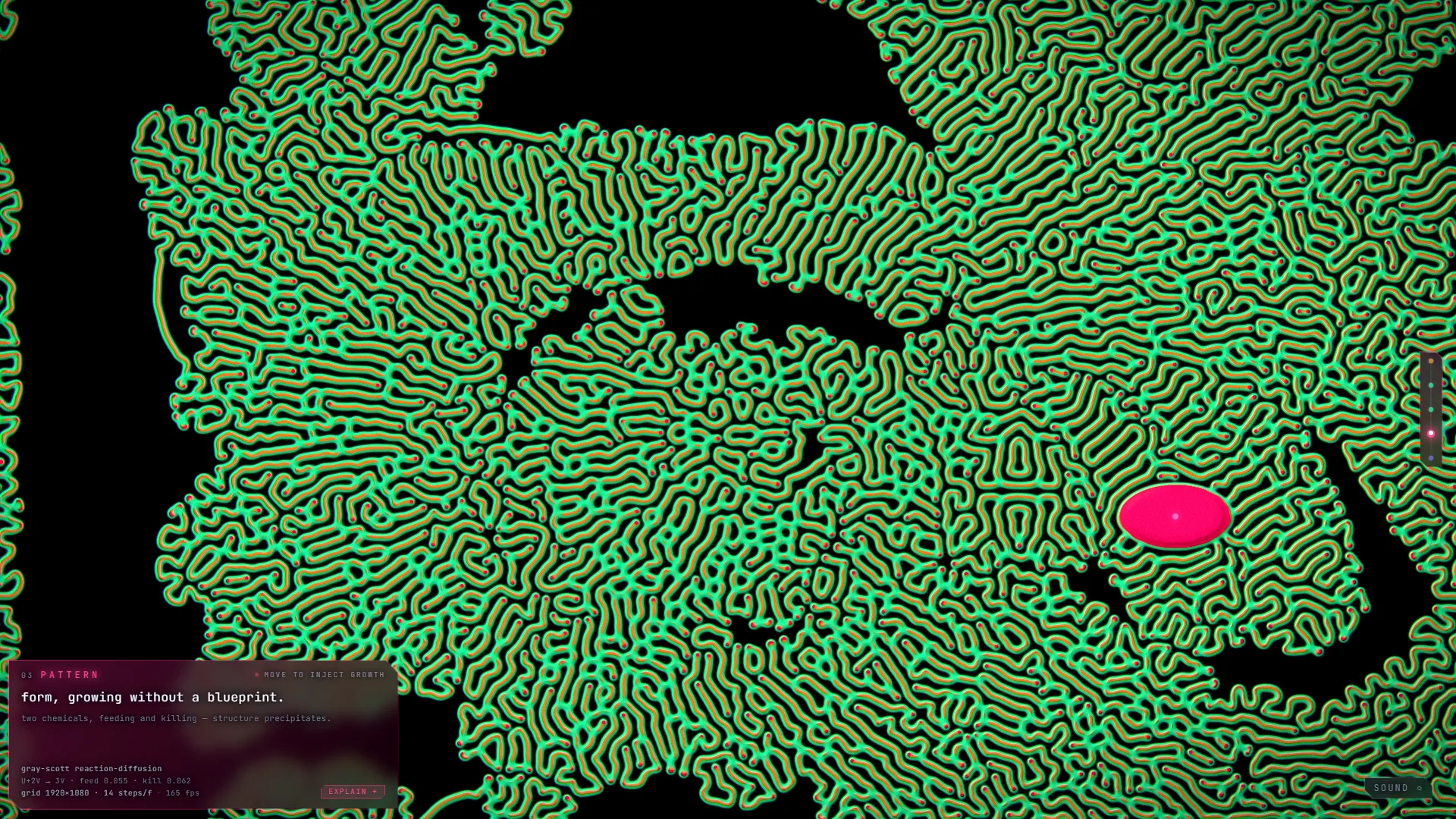
04Pattern
Two substances, one feeds, one consumes: the Gray-Scott equations in the regime Pearson described in 1993. The number of steps follows the clock, not the frame rate, otherwise the pattern would grow three times as fast on a fast screen.
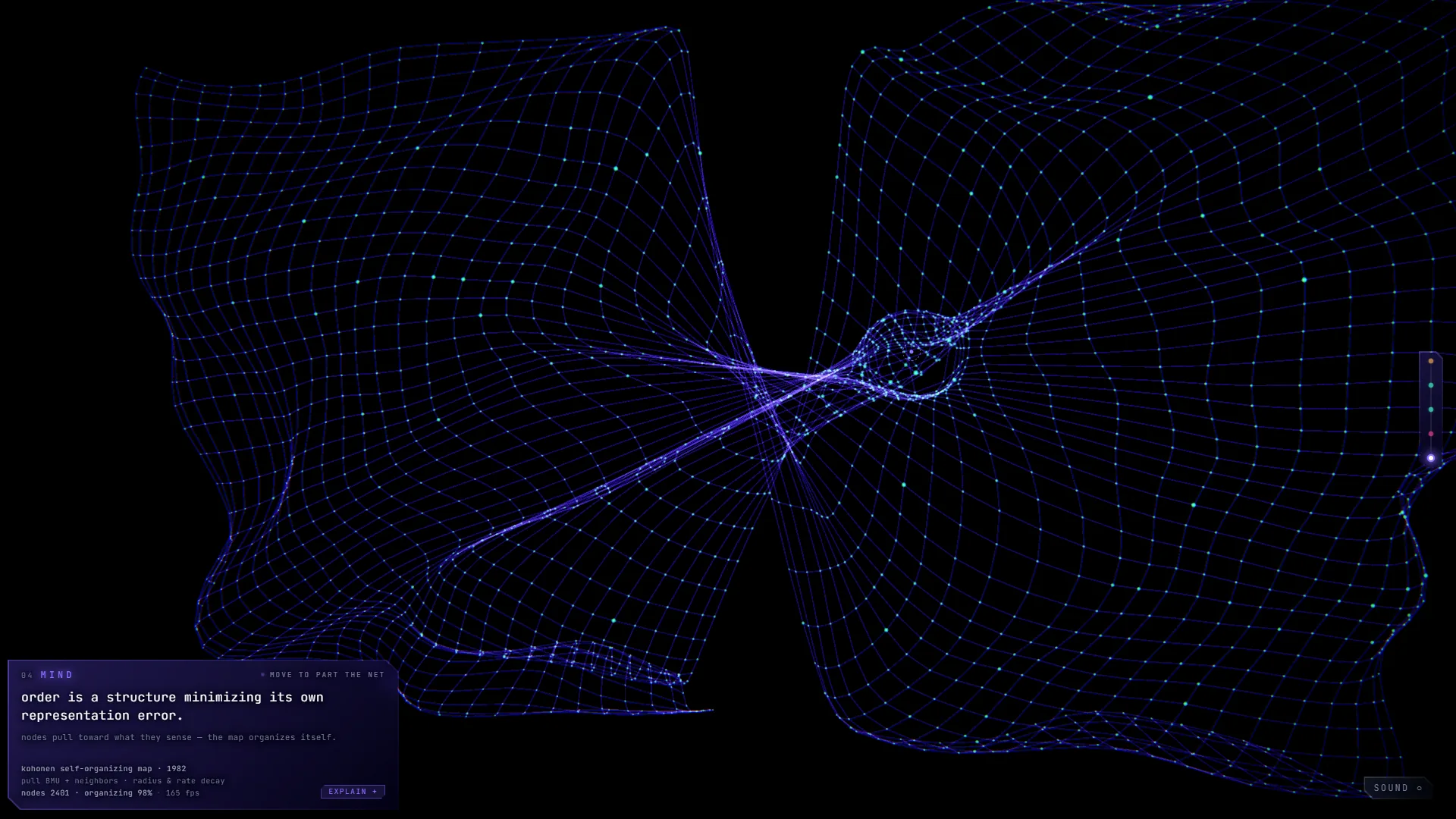
05Mind
A self-organising map following Kohonen, 1982: 2,400 nodes moving towards a distribution. As its learning target it gets the chemical pattern from the previous scene. Every hit makes its node flash.
Structure
The four transitions are the real subject. None of them is a crossfade, each one hands over a state. On take-off the board writes its live cells into the swarm’s position texture; what happens after that is physics, not a keyframe. The swarm stamps its flight path into the chemical field, and the map gets that field as its learning target. Three of the five systems run entirely on the graphics card. WebGL2 has no compute shaders, so every write becomes a draw call.
Decisions
At first the swarm had a point of attraction in the middle. It got there and stopped; in its place there is now a soft spherical shell that only turns back stragglers. The map initially started out pre-ordered, which skipped exactly the self-organisation the scene is meant to show. When things get tight, the simulation rate drops first and the resolution only after that: the cost depends on the number of agents. With reduced motion switched on, each scene shows a precomputed still image.

Publicly live, on any screen.
Enquiry
Tell me about your project.
A few details are enough for a first assessment.